Audit shapes behaviour. Not by preventing anything, it checks what happened after the fact, but because officers who know they will be audited make procurement decisions in advance to minimise the chance of adverse findings. The governance literature treats this as the mechanism working correctly. Fear of scrutiny produces better decisions. A peer-reviewed study published in the American Economic Journal: Applied Economics in October 2024 tested what decisions it actually produces. Above the audit threshold in Chilean public procurement, officers shifted from competitive auctions to direct contracting. Competition declined. Single-source awards increased. Familiar suppliers were more likely to win. Minimising adverse findings and achieving competitive procurement turned out to be different objectives.
The study, ‘Distortion by Audit: Evidence from Public Procurement’ (Gerardino, Litschig, and Pomeranz, 2024), used a regression discontinuity design exploiting the contract value threshold above which Chilean auditors were assigned to review procurement. Contracts just above and just below the threshold are otherwise identical. The only systematic difference is the probability of being audited. The study tracked what happened to procedure choice. Auctions declined. Direct contracting increased. Incumbent, local, and small firms were more likely to win contracts above the threshold — not because of preference policies, but because a direct award to a familiar supplier is a simpler record to defend than a multi-stage competitive process with more opportunities for something to have gone wrong. Chile’s procurement platform, Chilecompra, is frequently cited by the OECD and World Bank as a best-practice model. The distortion appeared there anyway. The platform is not the problem. The anticipation of audit is.
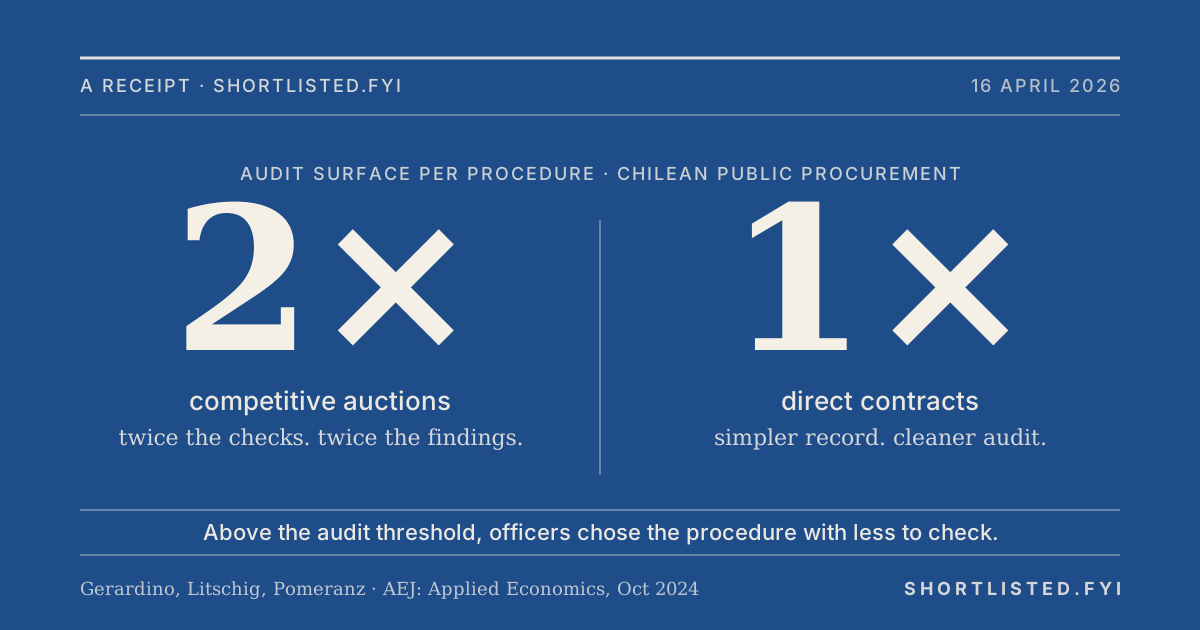
The mechanism is straightforward. Auctions underwent more than twice as many checks during audit as comparable direct contracts and generated twice as many detected infractions. The detection rate reflects the procedure, not the quality of the officer. Auctions have more steps. More steps means more surface area for audit to find a deviation. An officer who runs a correct auction is still more likely to emerge from audit with a finding against them than one who issues a direct award, because the auction simply has more to check. The rational response to a higher probability of being audited is to choose the procedure with less to check. Officers did. They were not cutting corners. They were reading the incentive correctly. Every system is perfectly designed to get the result it gets.
This is where the procurement governance literature has a problem it has not examined. It often treats audit as a check on whether competition occurred. What audit actually checks is whether the steps in the chosen procedure were followed. These are not the same question. A direct award that was properly documented generates fewer audit findings than a competitive auction with a paperwork gap, even though the direct award produced no competition and the auction did. The audit framework cannot distinguish between them, because it is not looking at whether competition occurred. It is counting whether steps were followed. Officers who want to minimise their audit exposure can read that framework as clearly as anyone else. The procedure with fewer steps is the direct award. Competition is, under this design, a liability.
The correct version of this analysis does not conclude that audit frequency should be reduced. It concludes that audit is checking the wrong thing. Detected infractions in a procedure measure adherence to process. They do not measure whether the procurement achieved its purpose. For a competitive tender, the purpose is a genuine market test: did multiple suppliers compete on consistent criteria, and is the outcome defensible without reference to prior relationships? For a direct award, the purpose is a credible account of why the market was not tested. Neither question is answered by counting whether procedural steps were completed. Both questions are harder to answer than step-counting. Both are what audit should be asking. A framework that counts steps will always make direct contracting look cleaner than competition. Under that framework, direct contracting is cleaner — from the perspective of the officer who will be audited.
Panel procurement makes the structure of this problem visible. A panel is established through a full competitive process — tender, evaluation, supplier selection. Every step is documented. After that, individual contracts can be placed with panel suppliers through secondary procurement, which New Zealand’s Auditor-General found is governed by rules so permissive that one organisation described them as ‘do whatever you like.’ The competition the panel’s establishment documented does not need to recur at the point where contracts are actually placed. The OAG’s review of four public organisations found that none of them were monitoring whether their panels were delivering the benefits the original competitive process was supposed to secure. One organisation, which had specifically wanted a faster procurement process, told the OAG: ‘there’s no benefits monitoring, we just know that it’s quicker.’ A step-counting audit of those panels confirms the correct procedure at establishment: competitive process conducted, suppliers selected, terms agreed, box ticked. It does not examine whether competition is occurring at call-off — because the competitive step has already been recorded. The OAG asked the question a step-counting framework never reaches: is the panel actually delivering what competition was supposed to achieve? That is what outcome-focused audit looks like. The answer, in every case, was that the organisations had not checked — but the OAG had.
The prescription that audit pressure improves procurement has circulated for decades without anyone checking what it produces for the officers who work under it. Gerardino, Litschig, and Pomeranz ran that check. Uniform audit pressure, applied to procedures of different complexity, produced less competition. The finding has been in the economics literature since 2024. Procurement publishing has not read it. Officers have figured out the same thing without the paper.
Sources: Gerardino, Maria Paula, Stephan Litschig, and Dina Pomeranz, ‘Distortion by Audit: Evidence from Public Procurement’, American Economic Journal: Applied Economics, Vol. 16, No. 4 (October 2024), pp. 71–108. https://www.aeaweb.org/articles?id=10.1257%2Fapp.20220512
Controller and Auditor-General, Getting the best from panels of suppliers, New Zealand Office of the Auditor-General, https://oag.parliament.nz