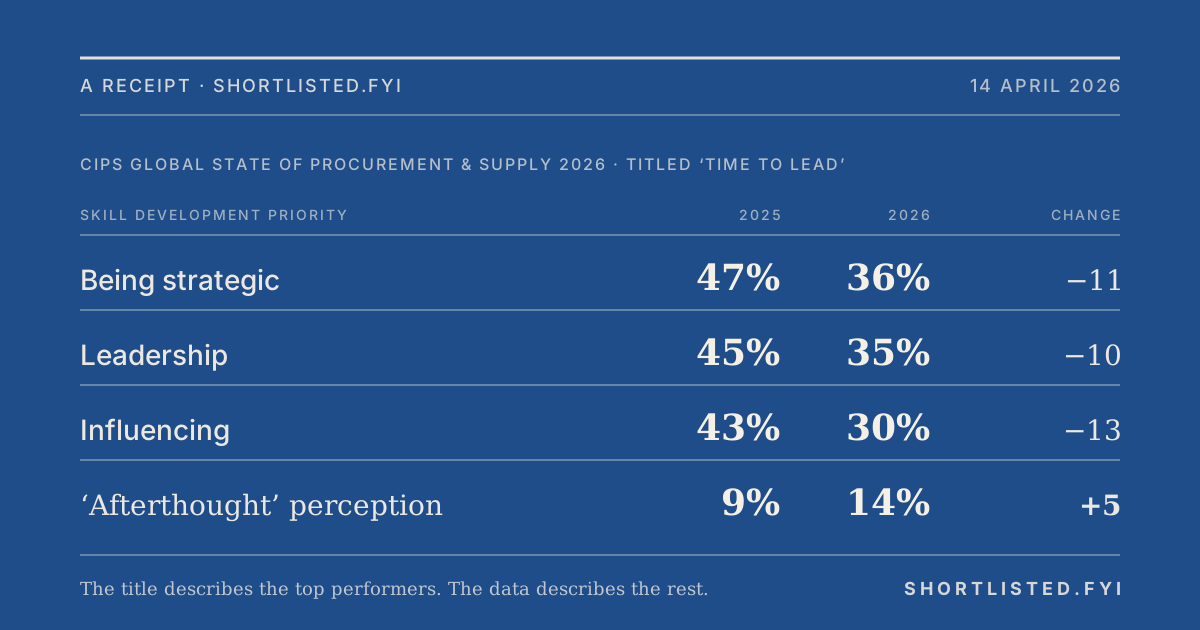
The CIPS State of Procurement and Supply 2026 report is titled ‘Time to Lead’. The data underneath it shows that ‘trusted business partner’ perception moved one point, from 36% to 37%. ‘Afterthought’ perception rose from 9% to 14%. Board seats fell from 25% to 22%. The three skills procurement professionals most wanted to develop in 2025 — being strategic, leadership, and influencing — all dropped 10 to 13 percentage points by 2026, replaced by new technology, risk management, and negotiation.
The title is not wrong about the best practitioners. It is wrong about the direction of travel for the function as a whole.
What the report leads with
The 2026 report’s headline finding is a doubling of the proportion of CPOs reporting directly to the CEO, MD, or owner: from 15% in 2025 to 33% in 2026. That is a significant shift and reporting lines can make a tangible difference. When the lead of the procurement function has a direct line to the CEO, they face fewer filters on strategic advice. If the 2025 and 2026 cohorts are comparable, roughly one in five procurement leaders gained a CEO reporting line in a single year. The composition of respondents explains more of the shift than a global realignment of procurement’s position on the org chart.
A reporting line is a softer measure than a board seat. A board seat carries fiduciary duty and legal exposure. It is scrutiny in both directions. The 2025 report celebrated the fact that a quarter of CPOs held a permanent seat on the main board. The 2026 report shows that figure at 22%, split 13% private sector and 9% public sector. The rise stopped. It is not in the report’s headline.
The CEO reporting line doubled; the board seat fell. The report leads with the doubled figure. The profession’s representative body emphasises the measure that moved in the right direction and does not name the one that didn’t. The 22% likely captures executive-committee attendance, small-company informal governance, and optimistic self-description more than it captures legal board membership. Even on the generous definition, the number stopped rising.
The skills picture
The 2025 CIPS report showed procurement professionals prioritising strategic and leadership skills. Being strategic came first, at 47%. Leadership second, at 45%. Influencing third, at 43%. Those are the skills of a function asserting a different identity: outward-facing, advisory, operating above the category level.
The 2026 picture is different. New technology tops the list at 47% (up from 41%). Risk management is level with it, also 47% (up from 36%). Negotiation comes third at 42% (up from 21%). Being strategic fell from 47% to 36%. Leadership fell from 45% to 35%. Influencing fell from 43% to 30%.
A 10 to 13-point retreat across all three strategic/leadership/influencing skills, in a single year, is not noise. It is a return to the technical box. Practitioners have decided that what they most need to develop is harder to negotiate, manage risk, and work the technology. Not to lead differently. Not to influence differently. Technology and risk: the language of the function under pressure, not the function advancing.
The perception data
Three categories. ‘Trusted business partner’: 36% in 2025, 37% in 2026 — flat. ‘Positive influence but sometimes a blocker’: 54% in 2025, 48% in 2026 — down six points. ‘Afterthought’: 9% in 2025, 14% in 2026 — up five points.
The middle category shrank. Where did it go? Not into ‘trusted partner’. The ‘trusted partner’ share gained one point. The six-point middle-category drain went almost entirely to ‘afterthought’. The perception move is not upward. The profession is not being seen differently and better. The professionals who were ‘positive influence but sometimes a blocker’ are being seen as an afterthought.
That is not a supply-side problem about practitioners not developing the right skills. It is a demand-side problem: the organisations these practitioners work in are reverting to treating procurement as a transactional function. The crisis window closed. The visibility that crisis created did not get converted into structural change.
The pattern this fits
I wrote earlier this year about the 6% gap in procurement performance: Kearney Leaders, Deloitte Digital Masters, State of Flux SRM Mature. Three firms, three methodologies, the same 6% of organisations appearing at the top. The gap between them and the rest has not closed across decades of transformation initiatives and capability investment.
The 6% analysis documented a specific dynamic from COVID: the best procurement functions rose to the occasion. Supply chain visibility, scenario planning, emergency sourcing — the top performers demonstrated, visibly, what strategic procurement looked like under pressure. The chasing pack got the same moment of visibility. Boards paid attention to procurement. CEOs called CPOs. The function had genuine relevance, and it knew it.
The convergence question was always what the chasing pack would do with that window. The CIPS data from 2025 suggested they were trying to consolidate it: board seats up, strategic skills prioritised, leadership and influencing on the development agenda. The 2026 data suggests the window closed before the conversion happened.
Board seats fell. Strategic skills deprioritised. More practitioners being seen as afterthoughts. The best continued to advance — the 33% CEO reporting line is real, and those relationships did not form by accident. But the population-level data shows retreat, not advance.
This is the COVID-era bifurcation running on schedule: the top consolidate, the chasing pack regresses when the crisis that gave them visibility stabilises.
What the survey cannot see
The CIPS Global State of Procurement and Supply is on its third edition. The 2024 survey ran to 122 respondents. The 2025 survey ran to 281. The 2026 survey ran to 555. The sample is not just growing; it is changing composition as the survey matures and reaches a broader population.
Any pattern longer than two years is invisible to this dataset. The comparison the 2026 report can make is to 2025. It cannot compare to 2019, or 2016, or 2012. It cannot say whether the current board-seat figure represents an advance from the pre-COVID baseline or a retreat from it. It cannot see whether the skills retreat is a blip or a return to a stable equilibrium.
The 6% research does have that longitudinal depth. Kearney’s AEP has run since 1992. The pattern it identifies is structural, not cyclical. The chasing pack has been trying to close the gap for three decades, and the gap has widened.
The CIPS survey is useful year-on-year intelligence. It is not a tool for reading the longer arc. CIPS is the profession’s representative body, and it does not hold the longer memory in this format.
The title problem
‘Time to Lead’ describes something real about the top performers. Some CPOs did convert their crisis visibility into structural access, and those relationships did not form by accident. The title fits them.
It does not describe the population-level direction of the data. The proportion of respondents with a CEO reporting line doubled, but the composition of the sample shifted in the same window, and the harder measure of board representation fell. ‘Afterthought’ perception is up. Strategic and leadership skills are being deprioritised. The middle of the distribution is compressing downward, not upward.
A more accurate title for the full dataset would be something like ‘The Gap Widened’. That title would not be welcomed. It would also be true.
Data from CIPS Global State of Procurement & Supply 2026 (‘Time to Lead’, 555 respondents, Nov-Dec 2025) and CIPS Global State of Procurement & Supply 2025 (‘Cool Heads in the Storm’, 281 respondents, Nov-Dec 2024). The 6% framework draws on Kearney’s Assessment of Excellence in Procurement 2017-2023/24, Deloitte’s Global CPO Survey 2019-2025, and State of Flux’s SRM Research 2018-25.