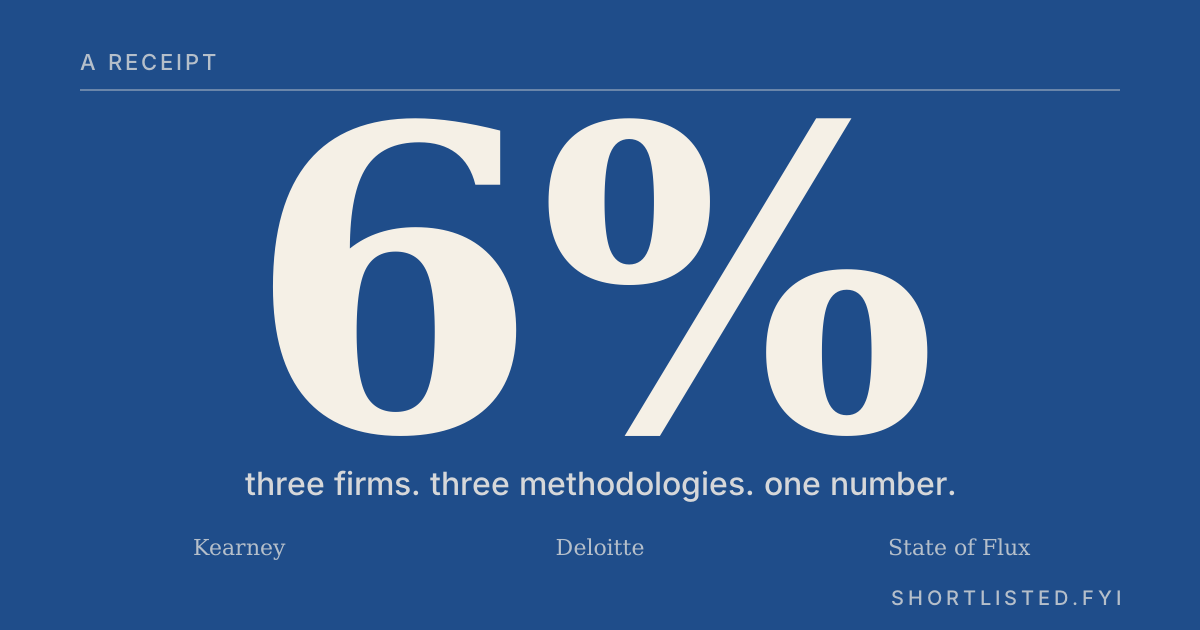
There’s a number that keeps showing up in procurement research. Different firms, different methodologies, different time periods, different aspects of the function. The number is six percent.
Kearney calls them Leaders. Deloitte calls them Digital Masters. State of Flux calls them SRM Mature. The labels shift. The figure holds.
Which means 94% of organisations sit somewhere on a spectrum from ‘barely covering costs’ to ‘adding value but not transforming fast enough’. The major consulting firms have documented this gap for decades. They have built practices around diagnosing it. They sell frameworks to close it. The gap is wider now than it was before the pandemic.
The convergence
Kearney’s Assessment of Excellence in Procurement for 2023/24 assessed over 1,000 companies across two dimensions: impact delivered across five value areas (margin, ESG, resilience, innovation, efficiency) and capability built across four pillars (demand, category, supplier, team). The Leaders generate two to three times more margin value than the rest, two to five times more strategic value, and 19% higher total shareholder return than industry peers. During COVID they maintained a 150 basis point advantage on procurement benefits as a percentage of EBITDA.
Deloitte’s 2025 Global CPO Survey, covering 250+ CPOs across 40+ countries, segments by digital maturity and operating model sophistication. The Digital Masters are roughly 10% of the sample. The gap between them and everyone else is accelerating.
State of Flux has focused almost exclusively on supplier relationship management since 2001. Its 2024/25 research finds 6-8% of organisations demonstrate mature SRM capability. 97% aspire to strategic SRM. 8% can deliver it. That is an 89-point aspiration-capability gap.
Three independent research programmes, three different lenses, same answer. When the methodology, the sample and the time period all vary and the number still converges, the number is signal.
What the 6% actually do
The research is consistent on what separates the Leaders.
They measure value beyond savings. Leaders track revenue uplift, innovation enablement, risk mitigation, stakeholder satisfaction. Deloitte found 58% of Followers have no formal tracking for revenue uplift, and 49% don’t track innovation enablement. They measure savings because Finance demands it. Everything else is invisible.
They treat supplier relationships as infrastructure. Leaders are four times more likely to run SRM programmes with formal governance. 61% of them can quantify financial benefit from SRM of 4% or more. 68% of Followers ‘don’t know’ what benefit they receive.
They allocate time differently. Digital Masters spend 34% more time on strategic activities than Followers. Leaders devote at least 70% of staff costs to strategic FTEs. The rest drown in approvals, transactions and firefighting.
They experiment with technology. Leaders are three times more likely to have generative AI pilots running, three times more likely to buy best-of-breed solutions rather than waiting for their ERP vendor. They treat analytics as a differentiator, not a spend report.
They have executive alignment. Twice as likely to have full CFO support. 90% report to C-level. Three times more likely to be involved in strategic planning, product development and M&A.
None of this is secret. The playbook sits in freely available reports.
The climb and the snap
Before the pandemic the profession was climbing. By 2019 Strugglers had dropped to around 25% of the Kearney sample. The Pack was learning from Aspirants. The distribution was shifting upward. Kearney’s 2017 report was titled Mobilizing for Excellence in Supply Management. State of Flux’s themes moved from ‘Entrepreneurial SRM’ in 2017 to ‘Harnessing and Growing Supplier Innovation’ by 2019, a more sophisticated conversation about suppliers as engines for R&D.
Then COVID. Supply chains collapsed. Suppliers went under. Procurement reverted to type: locking down, going defensive, controlling what could be controlled. Kearney’s data shows ten percentage points dropped from The Pack into Strugglers in a single year. A decade of progress erased in a quarter.
State of Flux’s 2020 report found 81% of supply chains were negatively affected and that relationship management was the single most effective mitigation tool, cited by 65% of respondents, beating contract management. The organisations with strong supplier partnerships received preferential treatment, priority allocation, flexibility on terms. The transactional buyers went to the back of the queue.
A watershed moment. Instead, by 2021, State of Flux found 82% of organisations had redefined value as cost reduction and cost avoidance. The lesson was learned and immediately forgotten.
By 2022 Kearney wrote: ‘C-suites recognise and appreciate procurement’s firefighting efforts over the past few years. But the core perception of procurement is unchanged.’ Procurement got credit for crisis response and failed to convert that credit into strategic positioning. Four years on, Strugglers have dropped from 35% to 33%. That is stagnation, not recovery. The Leaders kept moving. They used the crisis as an accelerant.
Why recovery stalled
Four compounding factors.
State of Flux has tracked procurement technology adoption for eight years. Automation levels have not improved. They have gone backwards. The CIPS 2025 survey confirms it: 41% of procurement functions are ‘not very automated’, and only 6% report very high automation. You cannot run strategic procurement on spreadsheets. 87% of organisations are still trying.
Deloitte found that technology funding dropped from 13.2% of procurement budget in 2021 to 10.9% in 2023. That was the period when generative AI emerged and digital capability became the primary differentiator between those who perform and those who don’t. Organisations cut technology investment precisely when the gap was widening. The Digital Masters allocate 24-26% of budget to technology. Followers are at 18-19% and falling. The gap compounds.
Talent investment is similarly mismatched. Digital Masters allocate 3.5% of budget to development versus 2.7% for Followers. Masters prioritise digital skills (72%), sourcing and category management (70%), data and analytics (57%). Followers prioritise sourcing and category management (64%), negotiation (53%), sustainability (44%). Followers are perfecting skills that AI will augment while ignoring the capability to use AI.
And the silo tax. The top barrier to value delivery reported by 57% of CPOs in the Deloitte survey is ‘siloed ways of working’. Procurement cannot manage tariff exposure without Tax, supplier risk without Legal, or adoption without IT. The Leaders never built the silos, or have spent years dismantling them. The rest are trapped inside walls of their own construction.
The diagnosis is free. The cure is six figures.
The firms that document the gap are the firms that sell the engagements to close it. The research is free. The help is not, starting at six figures, and the first digit is rarely a one.
This is not a conspiracy. It is the business model. But it produces a predictable outcome. The organisations that most need to improve get the diagnosis for free and a quote they cannot action. The research identifies gaps. The engagements close them, at a price that only the organisations with the least need can afford.
Every firm has a maturity model. Ad Hoc to Optimised to Leading Practice, with a neat ladder in between. Maturity models describe states, not transitions. They do not tell you what specific capability moves an organisation from Struggler to Pack, what sequence of investments makes sense in a given context, where the failure points are, how long each stage takes, or what each level costs. They show the levels. They do not show the stairs.
State of Flux quantified the result: 97% aspire to strategic SRM, 8% can deliver it. That 89-point gap is not primarily a capability problem. It is a definition problem. Ask ten procurement leaders what ‘strategic SRM’ looks like in their context and you get ten different answers, most of them vague. The frameworks describe the destination in detail while remaining silent on the journey.
The profession’s governing body could fill some of this space. CIPS publishes one annual survey. When asked which skills they want to develop, its members rank ‘developing teams’, ‘collaboration’ and ‘transparency’ near the bottom. These are the exact capabilities every piece of research identifies as separating Leaders from everyone else. CIPS reports the finding without comment.
LinkedIn rushes into the vacuum: the seven traits of world-class CPOs, the procurement-is-broken hot takes, the infographic that is actually a bulleted list with a colour gradient, the anecdote dressed as data. The content is not designed to help practitioners improve. It is designed to generate engagement. The algorithm rewards controversy, not usefulness.
Principles, not prescriptions
The research is valuable. The 6% are worth studying. The error is treating their practices as a blueprint to copy rather than a set of principles to adapt.
A $50B multinational implementing ‘measure what you want to improve’ might build a real-time analytics platform integrated across 50 business units. A $50M regional manufacturer implementing the same principle might add three new KPIs to the quarterly review and track them in a shared spreadsheet. Both are valid. The research describes the first and implies it is the only path.
Most procurement dysfunction is not a capability problem. It is an alignment problem. An organisation can have sophisticated category management capability that creates friction because it does not match what the business units need. It can have strong supplier management processes that become bureaucratic obstacles because they do not match how the organisation operates. It can have advanced analytics that generate expensive noise because nobody uses the insights. A capability matrix cannot diagnose alignment. Only context can.
The consulting approach starts with capability assessment, identifies gaps against best practice, and builds a roadmap to close them. This assumes best practice is the right target. It often is not. The better starting point is strategic context: what are the organisation’s imperatives, what do stakeholders actually require from procurement, where is the function breaking down in practice, and only then, which capability gaps matter for this specific situation.
The capability matrix tells you where you sit globally. The strategic questions tell you whether that matters.
What would actually close the gap
The industry is good at diagnosing and bad at solving. Closing the gap for the 94% requires four things the current model does not supply.
Continuous intelligence, not periodic assessment. By the time a two-year transformation roadmap is implemented, the target has moved. Real-time supplier intelligence, ongoing stakeholder feedback and persistent dysfunction detection beat the capability-assessment-every-two-years cycle.
Contextual recommendations, not universal frameworks. Guidance that starts with strategic imperatives and stakeholder needs, not capability matrices. ‘Given what this organisation is trying to achieve, here is what matters’ rather than ‘here is what Leaders do, you should too’.
Affordable access, not enterprise-only solutions. Intelligence and guidance at price points that make improvement possible for organisations that are not Fortune 500. The current model serves the organisations that need the least help.
Transition pathways, not destination descriptions. Explicit guidance on what specifically moves a Struggler into the Pack, what shifts an organisation from the Pack to Aspirant, where most organisations fail, and which capabilities must come first.
The 94% have a clear view of where they should be. They have no practical path to get there. The firms that produced the clear view also produced the absence of the path. The 6% is not the capability gap the research describes. It is the downstream effect of a research model whose economics require the gap to stay open.
Sources: Kearney, Assessment of Excellence in Procurement 2023/24; Deloitte, Global CPO Survey 2025; State of Flux, Global SRM Research 2024/25; CIPS, Global State of Procurement & Supply 2025.