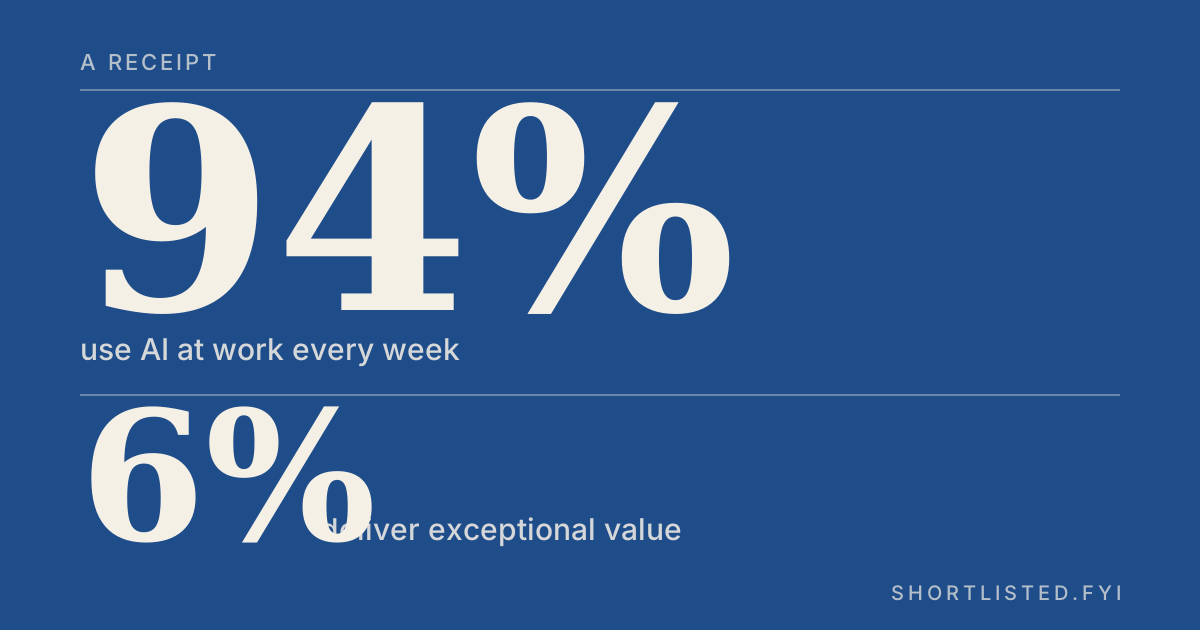
Focal Point’s 2026 procurement trends report leads with this claim: 94% of procurement teams already use generative AI tools at least once a week. The source is attributed to ‘AI at Wharton’. No methodology. No definition of ‘use’. No distinction between running a ChatGPT query to draft a supplier email and operating a functioning AI-integrated procurement stack.
The number is deployed as evidence of momentum. It isn’t.
Three independent research programmes (Kearney’s Assessment of Excellence in Procurement, Deloitte’s Global CPO Survey, and State of Flux’s SRM research) use different methodologies, study different aspects of the function, and cover different time periods. They arrive at the same number: roughly 6% of organisations are good at procurement. The rest sit somewhere between trying and failing.
If 94% of procurement teams use AI weekly, and 94% of procurement teams are not elite, the variable explaining underperformance is not access to AI.
Nobody asks whether the 6% have electricity. You assume it’s built into the infrastructure and invisible. That’s what real AI adoption looks like in a high-performing procurement function: demand forecasting models that don’t hallucinate, rules engines flagging contract anomalies that don’t need a prompt, OCR processing invoices that have been delivering quiet, compounding ROI for years. None of it makes the word cloud.
Wing VC’s State of AI in the Enterprise report called procurement, supply chain and finance ‘low uptake’. Customer service topped its ‘most impactful function’ list at 70%. Logistics and supply chain came in at 8%. Finance at 15%. The report was measuring LLM adoption. The functions it labelled slow are the ones that built actual AI infrastructure before anyone called it AI, and have no particular reason to be excited about a newer, less reliable version of what they already run.
The function has been here before. ERP. eSourcing. Spend analytics. Contract management platforms. Each was adopted widely. None closed the P&L gap. State of Flux tracked technology adoption across eight years and found automation levels in procurement did not improve. They went backwards.
Deloitte found technology funding dropped from 13.2% of procurement budget in 2021 to 10.9% in 2023. That was the period when generative AI emerged and digital capability became the primary differentiator between organisations that perform and organisations that don’t. The 6% who perform allocate 24-26% of budget to technology. The rest are at 18-19% and falling.
The leaders were already three times more likely to have generative AI pilots underway before the current wave. The gap between adoption and capability is not closing. It compounds every quarter the tools diffuse further into organisations that lack the strategic clarity to use them, the metric frameworks to evaluate them, or the executive alignment to act on what they produce.
94% are using AI the way they use everything else: to generate the appearance of work. The 6% built the infrastructure. They need answers, not statistics.
Sources: Focal Point, The Future of Procurement 2026; Wing VC, State of AI in the Enterprise 2025; Kearney, Assessment of Excellence in Procurement 2023/24; Deloitte, Global CPO Survey 2025; State of Flux, SRM Research 2024/25.