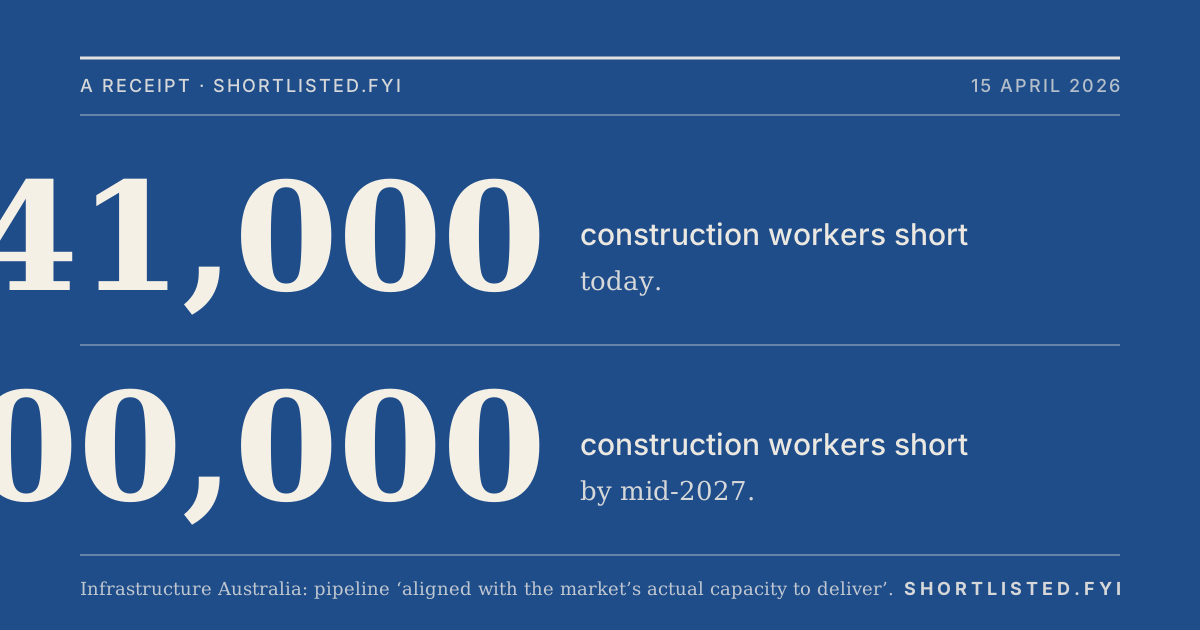
The 2026 Infrastructure Priority List claims to maintain a pipeline ‘aligned with the market’s actual capacity to deliver’ in order to ‘avoid bottlenecks in the construction sector’. Infrastructure Australia’s own Market Capacity Report puts the current construction workforce shortage at 141,000 workers. A new shortage peak of more than 300,000 workers is projected for mid-2027. These figures are not qualifications on the alignment claim. They are a direct contradiction of it.
The 2026 IPL, published in March 2026, identifies 68 nationally significant infrastructure proposals for federal government consideration over the next decade. The document states that prioritisation and sequencing are ‘important to ensure a sustainable pipeline with the delivery of the projects that matter most at the right time’. This is Infrastructure Australia’s description of what the IPL does. The Market Capacity Report provides the capacity data. The two documents are produced by the same organisation.
The Market Capacity Report shows the current workforce shortage is 56,000 lower than last year’s estimate. Infrastructure Australia’s explanation: the reduction ‘reflects demand being pushed out to the later years’. Projects that exceeded the market’s capacity to build them were delayed. Timelines slipped. Contractors could not find workers. The market enforced its own constraint. Infrastructure Australia then recorded that constraint and cited the resulting shortage reduction as evidence of a pipeline being responsibly managed.
This is not alignment. It is the documentation of market-imposed delay, described in planning language.
A capacity-aligned pipeline would set the total programme to a level the market can demonstrably deliver and refuse to add projects until measurable capacity exists for them. The 2026 IPL does not do this. It identifies 68 priority proposals across five pillars, noting that capacity is a consideration. It points to workforce initiatives and coordination efforts underway across governments and industry. It does not cap the pipeline at a number of projects the market can build, because that would require Infrastructure Australia to tell governments what they cannot commission, which is not a function any advisory body sustains for long.
The test of a capacity-aligned prioritisation is whether the list changes when capacity falls short. The list does not change. Projects that cannot be started in the near term shift to later years. New priorities join. The shortage builds again. The 2025 Market Capacity Report documented it. The 2026 IPL will generate a 2027 Market Capacity Report with the same structure.
What the same analysis looks like, done by someone who read both documents, is this: the IPL correctly identifies what Australia needs to build. The Market Capacity Report correctly identifies that the market cannot build all of it. Neither document contains a mechanism for resolving the gap between those two things. The IPL notes the gap exists. The Market Capacity Report measures it. The 300,000-worker shortage arriving in mid-2027 is not a forecast risk; it is what happens when a priority list that cannot say no meets a market that can.
Infrastructure Australia is not the only planning body that does this. Te Waihanga, New Zealand’s Infrastructure Commission, published its own National Infrastructure Plan in March 2026 carrying approximately $275 billion in projects, of which $193 billion is not yet fully funded. The plan’s executive summary states: ‘New Zealand is planning more projects than we can afford to deliver.’ Its response is sixteen governance and assurance recommendations. The pipeline was not shortened. The gap between the list of priorities and the list of deliverable projects is a structural feature of infrastructure advisory functions in most jurisdictions, because the function that produces the priority list is rarely the function that controls the budget, sequences the programme, or gives the market a commitment it can scale to. The IPL can identify 68 priorities. It cannot build any of them.
The next infrastructure project delayed by a shortage of workers will have been on the Infrastructure Priority List. The list identified it as nationally significant. The market rejected it for lack of capacity. Infrastructure Australia will record the delay as demand ‘being pushed out to the later years,’ which will reduce next year’s shortage figure, which will be cited as evidence the pipeline is being managed responsibly. The planning function did not align the pipeline with market capacity. The market did. Infrastructure Australia is calling that planning, when what they are really doing is creating a wish list.
Source: Infrastructure Australia, 2026 Infrastructure Priority List, March 2026, https://www.infrastructureaustralia.gov.au/2026-infrastructure-priority-list; Infrastructure Australia, 2025 Infrastructure Market Capacity Report, https://www.infrastructureaustralia.gov.au/reports/2025-infrastructure-market-capacity-report