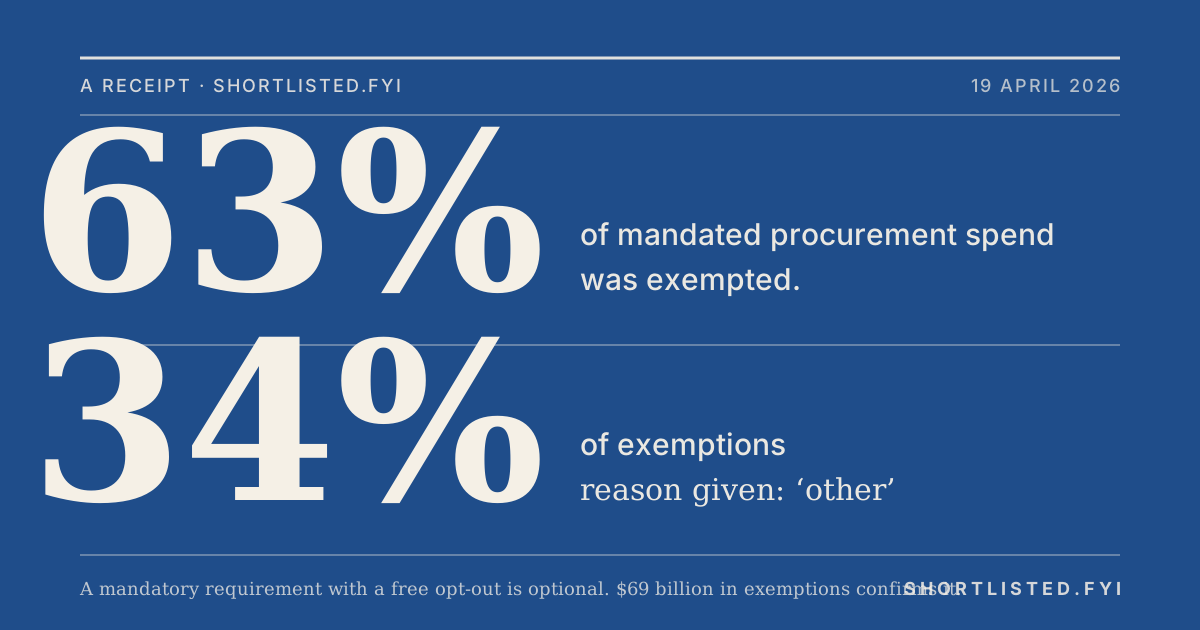
A procurement requirement labelled mandatory becomes optional when the exemption is a category called ‘other’. Between July 2016 and September 2024, entities subject to Australia’s Mandatory Minimum Requirements for Indigenous employment and supply use exempted 63 per cent of affected spend. The exemption mechanism was the policy’s most reliable feature.
The exhibit
ANAO Auditor-General Report No. 40 of 2024-25, published June 2025, assessed follow-up implementation of the Mandatory Minimum Requirements (MMRs) under the Indigenous Procurement Policy. The MMRs apply to contracts above $7.5 million in 19 nominated industries, requiring entities either to meet minimum Indigenous employment targets or to source from Indigenous-owned businesses, unless exempt. Of all contracts recorded in the Indigenous Procurement Policy Reporting Solution between July 2016 and September 2024, 63 per cent by value ($69.3 billion) were exempted. Of those exemptions, 34 per cent ($30.2 billion) used a single category: ‘other’. No criteria. No evidentiary standard. A tick-box.
Defence had the highest use of ‘other’, applying it to 59 per cent of its exemptions across $35 billion in spend. The Department of Foreign Affairs and Trade exempted 90 per cent of its affected contracts. Agriculture, 86 per cent. Education, 82 per cent.
The audit found that the National Indigenous Australians Agency (NIAA), which administers the policy, had not evaluated the MMRs’ impact on Indigenous employment or supply outcomes at any point since 2016. NIAA guidance on exemptions had not been updated since July 2020, despite changes to reporting requirements. The ANAO stated that use of the ‘other’ category ‘obscures the degree of non-compliance with the MMRs and is not appropriate.’
Why it is wrong
The procurement profession’s standard response to under-representation in government contracting is to mandate it. Set a value threshold. Attach a compliance requirement. Create reporting obligations. The MMRs followed this template and produced what any policy with a cost-free opt-out produces: widespread use of the opt-out.
An exemption category with no criteria is not a safety valve for rare cases. It is the rational default. Faced with the compliance burden of sourcing Indigenous suppliers, setting employment targets, and reporting outcomes, a procurement officer assesses the compliance cost against the exemption cost. When the exemption is a category called ‘other’, with no defined criteria, no evidence threshold, and no approval required outside the contracting team, the calculation takes seconds. Defence ran it on $20.65 billion and arrived at ‘other’. Foreign Affairs ran it on nine contracts in every ten.
The ANAO found that NIAA had not assessed the legitimacy of exemptions and that the guidance available to contract managers was inadequate and out of date. Nine years passed between the MMRs’ introduction and the follow-up audit. In that time, no mechanism constrained use of the ‘other’ category and no system flagged the volume of exemptions as a policy failure.
What the same observation looks like, written by someone who read the source
A meaningful mandatory procurement requirement needs properties the MMRs lacked. Exemption categories require specific, bounded criteria with documented evidence, not a catch-all option. Approvals need to sit outside the contracting team. The policy needs to define what success looks like before mandating compliance, not nine years afterward.
The NIAA’s non-evaluation is not a gap in implementation. It is the logical result of designing a policy that measures documentation rather than impact. Without a defined outcome measure, there is no success to evaluate. After nine years, the question of whether the MMRs increased Indigenous employment or supply use cannot be answered. That absence tells you what the policy was tracking. It was tracking forms.
The punch
In February 2025, the Australian Government announced reforms to the Indigenous Procurement Policy: a higher annual value target, a changed definition of Indigenous business. The ‘other’ exemption category was not removed. A policy that cannot tell you whether nine years of mandatory requirements changed anything has not been reformed. It has been continued.
Source: Australian National Audit Office, Targets for Minimum Indigenous Employment or Supply Use in Major Australian Government Procurements — Follow-up, Auditor-General Report No. 40 of 2024-25, June 2025, https://www.anao.gov.au/work/performance-audit/targets-minimum-indigenous-employment-or-supply-use-major-australian-government-procurements