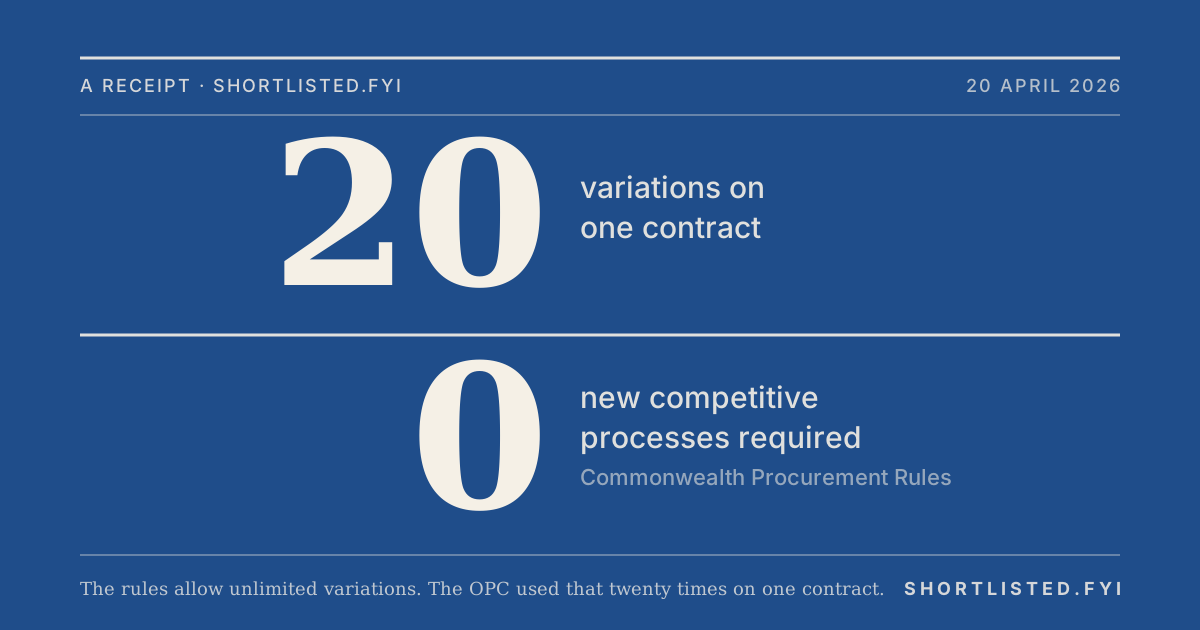
The Commonwealth Procurement Rules allow agencies to vary existing contracts without running a new competitive process. This is not an exception. It is a standard provision of the rules. Its predictable consequence is that agencies facing expanding scope have two paths: run a new procurement (competitive, procedurally demanding, time-consuming) or vary the existing contract (no competition required, procedurally simple, immediate). When the choice is between those two options, the rational move is the variation.
The ANAO’s December 2025 audit of the Office of Parliamentary Counsel’s procurement of a new Federal Register of Legislation found exactly this in practice. One contract was varied twenty times. Nine of the thirteen procurements examined were amended, increasing total costs by 125 per cent — from $6 million to $13.5 million — through variations alone. Twelve of thirteen procurements had no evaluation criteria in the request documentation; suppliers were not told how they would be assessed. In one case, OPC awarded a contract to the candidate ranked lowest against the evaluation criteria. The project began with an estimated budget of around $4.2 million and finished at $11.8 million after a four-year delay, a 181 per cent increase. The ANAO rates the procurement ‘partly effective’.
By what standard is twelve-of-thirteen procurements without evaluation criteria ‘partly’ rather than ‘largely’ ineffective? The evidence supports a harder conclusion than the audit reaches. But that is the secondary problem.
The ANAO warns that agencies ‘should not use contract variations to significantly change the scope of deals or to avoid obligations under the Commonwealth Procurement Rules.’ This is a statement of preferred practice. It is not a change to the rules. The rules place no limit on how many times a contract can be varied or by how much. As long as that remains true — as long as no threshold of cost increase or scope change triggers a new competitive requirement — the OPC’s behaviour will be repeated by OPC and by every other agency that faces expanding scope and a frictionless path through variations.
What the variation mechanism does in practice is create an unacknowledged procurement exemption. A formal exemption from competitive procurement requires documentation, justification, and approval. A contract variation requires none of those when the contract already exists. The practical effect is identical: work is awarded to the incumbent without competition. The procedural path is categorically different: one is an acknowledged departure from competitive requirements, one is ordinary contract management. The rules treat them as distinct. The incentives make them equivalent.
Twenty variations on one contract is not the story of an agency that broke the rules. It is the story of an agency that used the path the rules provide. The audit found non-compliance. It did not find the rule design that makes non-compliance rational. The rules remain unchanged.