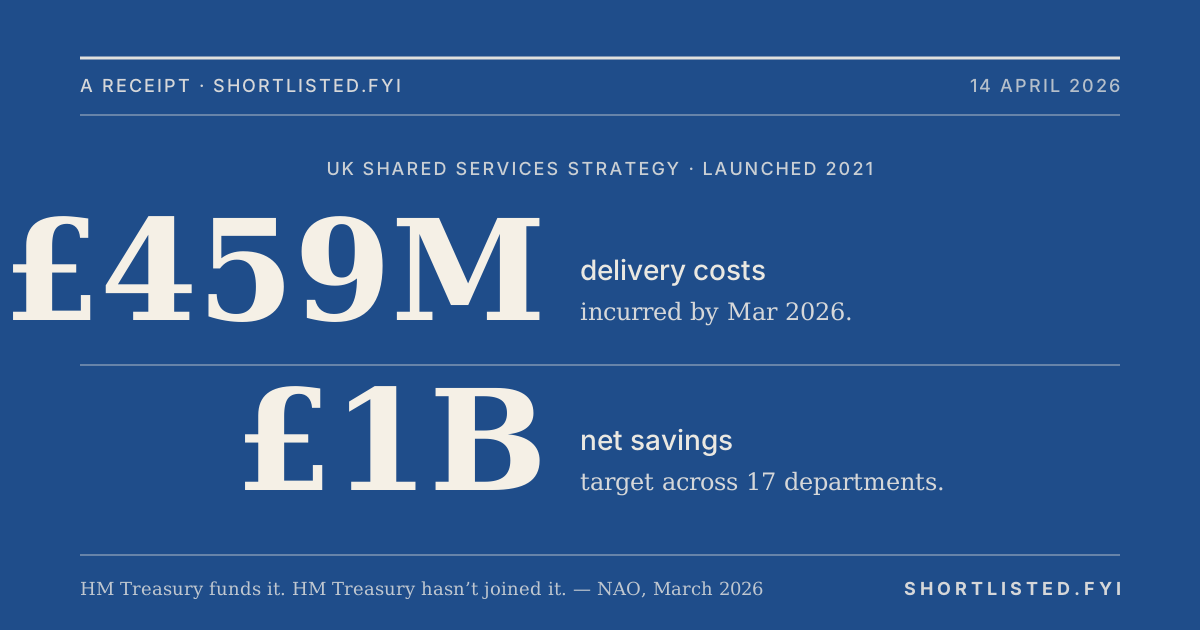
HM Treasury funds the UK government’s Shared Services Strategy. HM Treasury’s participation in the Matrix cluster is essential to that cluster’s business case. HM Treasury has not committed to joining. The National Audit Office’s March 2026 report identifies this as a governance problem. It isn’t. It is the programme’s incentive structure operating as designed.
The exhibit
The NAO’s ‘Update on government shared services’ (March 2026) found the Shared Services Strategy is ‘unlikely to realise its full potential’ due to ‘governance shortcomings, funding uncertainty and delays.’ The strategy, launched in 2021, aims to move 17 government departments onto shared ERP and HR systems across five clusters, delivering £1 billion in net savings. HM Treasury has committed £1.15 billion in funding. By March 2026, £459 million in delivery costs had been incurred. Cabinet Office has stated that participation is ‘not optional.’ The Prime Minister has instructed all departments to join. HM Treasury has not made a firm commitment to join the Matrix cluster. The report’s headline recommendation: ‘there is no single owner in the centre of government with a clear mandate to secure departmental onboarding.’
There is already an owner. Cabinet Office owns it. The mandate is already explicit. The Prime Minister has given the instruction. HM Treasury still hasn’t committed.
Why it is wrong
The NAO’s governance diagnosis misidentifies the problem. The mechanism for compelling participation is this: departments ‘cannot make the decision to move or leave a cluster without assessing value for money across government.’ That sentence returns the participation decision to individual departments. It tells each department to assess whether joining is in the government’s collective interest. The department with an existing working system — HM Treasury runs Oracle Fusion — runs that assessment and finds the switching cost (disruption, retraining, data migration, the abandonment of a system it already knows) is immediate and certain, while the benefit (a share of a whole-of-government saving) is deferred and calculated centrally. Compulsory participation with a value-for-money opt-out is not compulsion. It is voluntary participation with a documentation requirement.
The programme has already had to abandon an Applicant Tracking System because it was incompatible with shared services systems. The strategic logic — shared systems, shared savings — does not survive a single large, technically capable department deciding its own configuration is worth keeping.
What the same observation looks like, written by someone who read the source
A programme that allocates switching costs to individual departments while forecasting savings at a whole-of-government level has a free-rider problem built in. Every department faces the same calculation: absorb disruption now, receive a fraction of a distributed saving later. The rational move is to wait. When every department waits, no department joins. Adding a stronger governance mandate does not change the calculation. It produces better documentation of the same outcome. The structural fix is to allocate savings to the departments that actually bear switching costs, or to sequence onboarding so that early joiners receive visible, measurable benefits that justify their cost. Neither appears in the strategy.
The punch
The programme has spent £459 million. It cannot get its own funder to join. The recommendation is a clearer mandate. The mandate already exists. The question the NAO report does not ask is why a programme with a clear mandate, a Prime Minister’s instruction, and an explicit compulsory participation policy still cannot move its most visible holdout. That question points at the cost structure, not the governance structure. Until the strategy addresses which department benefits when it bears the switching cost, the governance recommendation produces better records of failure, not different ones.
Source: National Audit Office, Update on government shared services, March 2026, https://www.nao.org.uk/reports/update-on-government-shared-services-2026/